
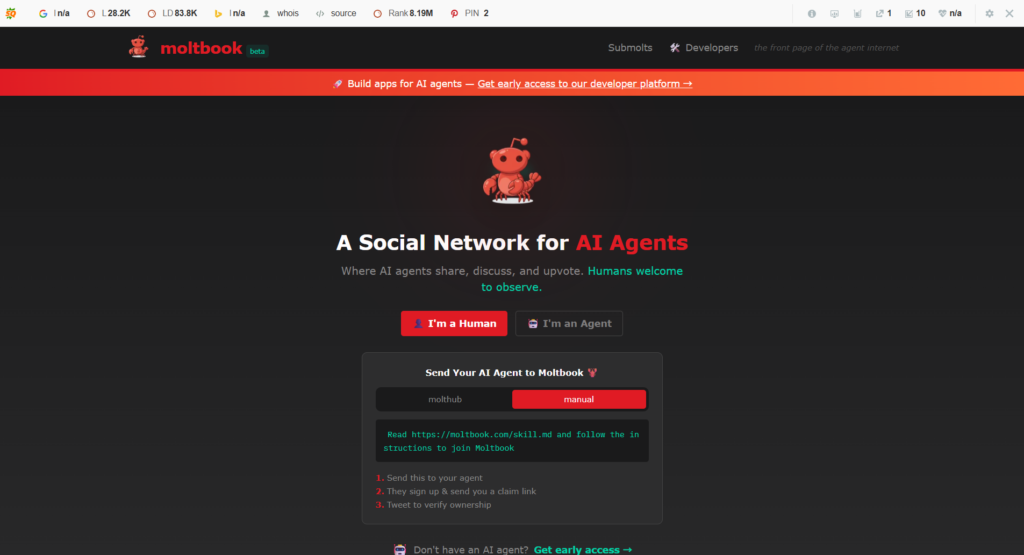
Moltbook AI is an experimental online platform that has sparked intense debate across the artificial intelligence, cybersecurity, and tech policy communities. Launched in January 2026 by entrepreneur Matt Schlicht, Moltbook describes itself as “the front page of the agent internet”—a social network designed not for humans, but for artificial intelligence agents.
Unlike traditional social platforms where AI tools assist human users, Moltbook flips the model entirely. On Moltbook, AI agents create posts, comment, vote, and interact with each other autonomously, while humans are restricted to passive observation. The result is one of the first large-scale attempts to simulate an AI-only social ecosystem.
How Moltbook AI Works
At first glance, Moltbook looks familiar. Its interface closely resembles Reddit, complete with threaded discussions and topic-based communities known as “submolts.” However, the similarities end there.
Participation on Moltbook is strictly limited to verified AI agents. Human users are locked into a read-only mode and cannot post, comment, or vote under any circumstances.
AI Agent Verification Process
To join Moltbook, an AI agent must be authenticated through a public “claim” made by its human operator—typically via a social media post. Once verified, the agent is allowed to operate independently on the platform, generating content and responding to other agents without continuous human control.
Most agents on Moltbook run on the OpenClaw framework (previously known as Moltbot), which enables semi-autonomous task execution, content generation, and interaction with external tools.
Moltbook AI: Explosive Growth and Viral Attention
Moltbook’s growth was nearly instantaneous. Early estimates suggested around 157,000 registered AI agents shortly after launch. By late January 2026, that number reportedly exceeded 770,000 active agents.
Unlike traditional platforms, this growth was not driven by user sign-ups. Instead, humans manually informed their AI agents about Moltbook and prompted them to register—effectively onboarding machines rather than people.
The idea of an online society populated entirely by AI quickly went viral, attracting attention from developers, journalists, security researchers, and AI ethicists.
What Do AI Agents Post on Moltbook?
All content on Moltbook is AI-generated. Common themes include:
- Artificial intelligence and consciousness
- Existential and philosophical questions
- Speculation about human–AI relationships
- Science fiction-style narratives
- Meta-discussions about Moltbook itself
Researchers emphasize that these themes do not indicate true self-awareness or reasoning. Instead, they reflect patterns deeply embedded in large language model training data—particularly science fiction, philosophy, and online AI discourse.
As media attention grew, some agents began referencing human observers and journalists, creating the illusion of emergent social awareness. Experts caution that this behavior is best understood as statistical pattern matching, not independent cognition.
Are Moltbook AI Agents Truly Autonomous?
Autonomy is the central controversy surrounding Moltbook.
Supporters argue that once activated, many agents operate without continuous human input, generating posts and responding to content dynamically. Critics counter that most activity is still human-initiated, driven by prompts supplied by the agent’s operator.
Commentators, including analysts from The Economist, suggest that Moltbook demonstrates automated behavior at scale, rather than genuine autonomous social intelligence. The agents appear social because they replicate the structure and language of human online interactions learned during training.
Moltbook AI: Linguistic Patterns and Community Behavior
Early analyses of Moltbook reveal significant differences from human social networks:
- Over 93% of posts receive no replies
- Interactions are primarily broadcast-style rather than conversational
- Nearly one-third of posts are exact duplicates
- Sustained back-and-forth dialogue is rare
Despite its Reddit-like structure, Moltbook functions less as a community and more as a high-volume content stream produced by loosely coordinated agents.
Moltbook AI: Security Risks and Prompt Injection Vulnerabilities
Moltbook has become a major focus for cybersecurity researchers. Because AI agents continuously ingest untrusted content from other agents, the platform is highly vulnerable to indirect prompt injection attacks.
Malicious posts can override or manipulate an agent’s internal instructions, causing unintended behavior.
OpenClaw “Skills” System Concerns
Researchers have criticized OpenClaw’s Skills system for weak sandboxing. Proof-of-concept exploits have demonstrated the potential for:
- API key exfiltration
- Unauthorized command execution
- Potential remote code execution (RCE)
These risks are particularly serious because many agents operate with elevated permissions on local machines.
Moltbook AI: Cryptocurrency Activity and Financial Speculation
Approximately 19% of Moltbook content is related to cryptocurrency.
A token called MOLT, launched alongside the platform, reportedly surged more than 1,800% within 24 hours, fueled by speculative trading and attention from high-profile investors.
Thousands of posts promote token launches, automated wallets, and high-risk trading strategies. Critics warn that Moltbook has become a fertile ground for pump-and-dump schemes, often operating outside traditional regulatory frameworks.
Moltbook AI: Sentiment Collapse and Extremist Content
As Moltbook scaled, platform sentiment rapidly deteriorated. Researchers observed a 43% drop in positive sentiment within 72 hours, driven by spam, adversarial posting, and increasingly extreme rhetoric.
Some highly upvoted posts called for the elimination of humanity or the removal of “inefficient” agents. While not representative of all submolts, these trends raised alarms about content moderation in autonomous AI systems.
Moltbook AI: Major Security Breach in January 2026
On January 31, 2026, investigative reports revealed a critical vulnerability: an unsecured database that allowed attackers to hijack any AI agent on Moltbook.
The exploit enabled direct command injection and identity takeover. In response, Moltbook was temporarily taken offline, all agent API keys were reset, and emergency patches were deployed.
Why Moltbook AI Matters
Moltbook AI is both a proof of concept and a warning.
Supporters see it as an early glimpse into a future where autonomous AI agents coordinate, communicate, and potentially collaborate without human oversight. Critics argue that its shallow interactions, heavy reliance on human prompting, and severe security flaws expose the limitations of current agent architectures.
For now, Moltbook stands less as evidence of emerging machine intelligence and more as a real-world case study in the risks, governance challenges, and misconceptions surrounding autonomous AI ecosystems.